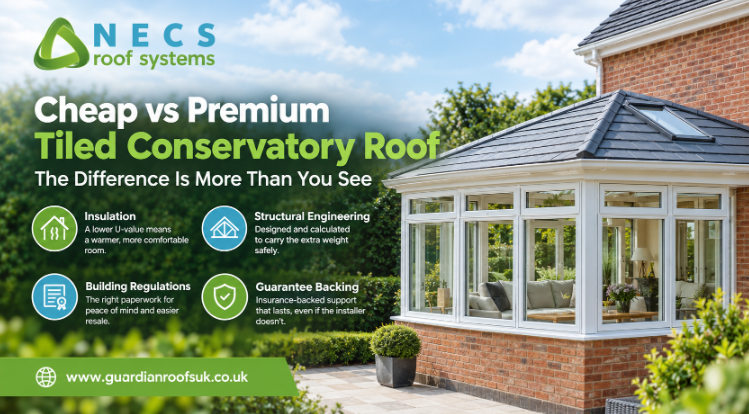
Quick answer: The gap between a cheap and a premium tiled conservatory roof is mostly what you can't see from the garden. A budget kit usually saves money on insulation depth, structural engineering, paperwork and guarantee backing. A fully approved system includes all four. Two roofs can look identical on the day and perform very differently ten winters later.
You've had three quotes for a tiled roof and they're nowhere near each other. One is far lower than the rest, the salesperson is friendly, and the photos look the same as everyone else's. It's natural to wonder what the extra money actually buys.
This is the honest answer. It covers where a cheap vs premium tiled conservatory roof really differs, what to ask for in writing, and when a budget conservatory roof can still be a sensible choice.
Why tiled roof quotes vary so much
Every tiled roof looks similar once the tiles are on. The differences sit underneath them. A lightweight tile kit can be sold as a simple product: panels, a ridge, some insulation board and a box of tiles. A fully engineered system is closer to a small roof structure, designed, calculated and documented before anyone climbs a ladder.
That design and paperwork work costs money, and it is the first thing to disappear when a quote is squeezed. So the price gap isn't random. It's usually made of the same four things, covered below.
1. Insulation: what's in the roof, not just how thick it looks
Most buyers ask "how thick is it?" The better question is what it's made of, how it's built up, and whether the figure is written down.
The measure to ask for is the U-value, which tells you how much heat passes through the roof. A lower number means a warmer room. A budget kit may use a thinner build-up or leave gaps at the edges and junctions, where a metal frame can carry heat straight out of the room. That's called thermal bridging, and it's why a roof can look thick and still feel cold.
Ask for the U-value for the actual roof being quoted, in writing, and ask how the edges are dealt with. A confident installer can answer both. A vague one is telling you something.
2. Structural engineering: can the base carry it?
A tiled roof is heavier than the glazed one it replaces. That weight has to travel down through the frames and the dwarf wall, which is the low brick wall the conservatory sits on, without overloading anything.
On a proper system, the load has been calculated and the roof is designed around it. On a cheap kit, the load question can get skipped. The risk isn't that every budget roof fails. It's that nobody has checked. If a frame starts to bow, panels can shift, joints open up and leaks follow.
A surveyor should look at the dwarf wall and frames before quoting. If someone gives you a firm price from a phone call and a few photos, treat that price as a guess.
3. Building regulations: the paperwork you'll need later
Swapping a glazed roof for a solid one normally brings building regulations into play. In England and Wales that means building control approval. Scotland uses a building warrant through the local council, and Northern Ireland has its own system. A system that has been through LABC (Local Authority Building Control) approval gives you a clearer route to a sign-off certificate.
This matters most when you sell. A buyer's solicitor may ask for the certificate. Finding out then that it was never applied for is a painful, expensive conversation. So ask who applies, who pays, and who collects the final certificate, and get the answer in writing. Check with your local building control team too, as the requirements for your particular project depend on the work involved.
4. Guarantee backing: who pays if it goes wrong?
Every installer offers a guarantee. The useful question is what stands behind it.
A guarantee from a small firm is only as good as that firm's survival. An insurance-backed guarantee carries on if the installer doesn't. Guardian Warm Roofs, for example, come with an insurance-backed guarantee when installed in line with the official installation guide. Read what any guarantee covers, how long it lasts, and what conditions apply before you rely on it. Confirm the details on the quote itself rather than from a brochure.
Cheap vs premium tiled conservatory roof: side by side
| Budget kit (typical) | Fully approved system | |
| Insulation | Often a thinner or simpler build-up | Specified build-up with a stated U-value |
| Structure | Load may not be calculated | Designed and calculated for load |
| Paperwork | Compliance route can be unclear | Defined route to building regs sign-off |
| Guarantee | Depends on the installer | Insurance-backed when installed to guide |
| Quote | Often fixed before a survey | Written quote after a survey |
This is a general pattern, not a rule for every cheap roof. Some budget quotes are fine, and some expensive ones disappoint. The table shows what to check, not what to assume.
Is a budget conservatory roof ever the right call?
Sometimes. If your conservatory is rarely used, you're planning to sell soon, or you only need to stop a leak, a basic option may be enough. What matters is that you choose it knowing what it leaves out, rather than finding out later.
A budget conservatory roof becomes poor value when you expect it to turn the room into a year-round living space. A roof that needs reworking, or an insulation level that never quite fixes the cold, costs you twice. A decent test is to ask what you want the room to do. If the answer is "be a proper room", the spec has to match.
What a fair quote looks like
Whichever way you lean, a good quote has certain things in common:
- It follows a survey of your frames and base, not a phone call
- It names the roof system and states the insulation value
- It explains how building control approval is handled
- It says what the guarantee covers and who backs it
- It is a written quote, because pricing depends on the size, shape and condition of your room
Warning signs are simpler. A price given without anyone looking at your conservatory, pressure to sign today for a discount, a large deposit up front, and answers that go vague when you ask about insulation or paperwork.
What to do next
Line up your quotes and compare the four points above, not just the bottom line. If one quote can't answer them, that tells you why it's cheaper.
If you'd like to see what a fully engineered system involves, the Guardian Roof page sets it out, and the guide to a tiled conservatory roof explains how tiled options work in more detail. A free survey will tell you whether your existing frame and base can take a tiled roof and what that would involve for your conservatory.