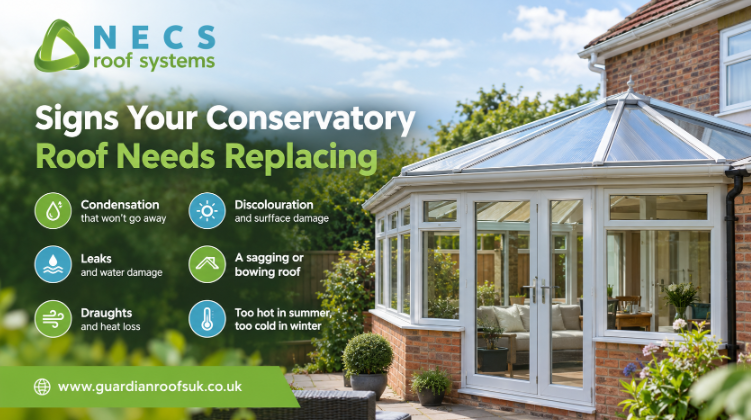
Quick answer: Your conservatory roof probably needs replacing if you see several of these together: condensation that keeps coming back, leaks, draughts, discoloured or cracked panels, a bowing roof, or a room you can’t use for months of the year. One minor fault can often be fixed. A pattern of faults usually means the roof has reached the end of its useful life.
Most people don’t wake up one morning and decide to replace their conservatory roof. It builds slowly. You stop using the room in January. You put a bucket out in a storm. You notice the roof has gone a slightly odd colour. Then one day you’re searching for the signs your conservatory roof needs replacing and wondering whether yours is bad enough.
This guide is a straight checklist. It covers what to look for, what each sign usually means, and when it’s worth booking a survey.
Condensation that won’t go away
A bit of condensation on a cold morning is normal in any glazed room. It’s the pattern that matters.
Look at where it appears. If your roof is polycarbonate and you can see moisture, mist or green algae inside the sheets, between the layers, the seals have failed and water has got in. That can’t be cleaned out. The sheet is finished.
If it’s on the inside surface of the roof, running down the glazing bars and dripping onto the floor most mornings through autumn and winter, the roof is too cold. Warm, damp air from the room is hitting a cold surface. You can use a dehumidifier and open a window, but that treats the symptom. The roof is the cause.
Leaks
Leaks are the sign people tend to put up with longest, and the one that causes the most damage if you ignore it.
Check after heavy rain, not on a dry day. Look along the glazing bars, at the ridge, in the valleys if your conservatory has them, and where the roof meets the house wall. That join is one of the most common places for water to find a way in. Also look at the gutters and the frame itself for stains, flaking paint or soft timber.
The honest judgement call is this. A single leak from one failed gasket or a cracked pane can often be sorted without replacing the whole roof. Leaks in two or three places, or a roof that has been patched more than once, is usually a sign the sealing and fixings are tired across the board.
Draughts
Stand in the conservatory on a windy day and hold the back of your hand near the glazing bars, the ridge and the eaves. Rubber gaskets perish over the years and shrink back from the glass or panels, leaving small gaps. You’ll also hear the roof rattle in the wind, or whistle.
Draughts matter because they work against everything else. You can fit blinds and a heater, but if warm air is escaping through the roof you’re paying to heat the garden.
Discolouration and surface damage
Polycarbonate sheets yellow, cloud and turn brittle with age and sunlight. Glass stays clear but the seals around it don’t. Here’s what to look for:
- Yellow, green or milky panels that no longer look clean even after washing
- Black mould spots on the frame or ceiling area
- Cracks, chips or hairline splits in panels
- White powdery marks or flaking on aluminium frames
- Peeling paint or stained timber near the roof line
How quickly this happens depends on the quality of the original sheets and how exposed the site is. A south-facing conservatory in full sun will age faster than a shaded one. Treat age as a prompt to look harder, not a verdict on its own.
A roof that sags or bows
Look at the roof from the garden, then from inside. Is the line straight? Do any panels dip or bulge? Do the glazing bars look bent? Any visible movement is serious, because it can mean the roof is no longer sitting properly on the frame, or that the frame itself has moved.
This is also the point where the structure beneath the roof becomes the main question. A new roof is only as good as the frames and dwarf wall (the low brick wall the conservatory sits on) underneath it. A surveyor will check these first, so it helps to look yourself for cracks in the brickwork, doors or windows that stick, and gaps opening up at the corners.
Too hot in summer, too cold in winter
This is the complaint we hear on almost every first phone call. A glass or polycarbonate roof has very little insulation. It heats up fast in sun and loses heat fast in the evening.
Ask yourself an honest question: how many months a year do you actually use the room? If the answer is “April to September, and only in the morning or evening”, the roof is working against you. When to replace a conservatory roof often comes down to this. If the room is meant to be part of your home but behaves like a greenhouse, it’s time to think about change.
Noise is part of the same picture. If heavy rain on a polycarbonate roof drowns out the television, that’s another sign you’ve outgrown it.
A quick checklist you can run yourself
Walk round your conservatory with this list. Give yourself one point for each one you can honestly tick.
- Condensation inside the roof most mornings in colder months
- Moisture or algae trapped inside polycarbonate sheets
- One or more leaks after heavy rain
- Draughts or whistling at the bars, ridge or eaves
- Yellowed, cloudy, cracked or brittle panels
- Mould, staining or flaking on the frame or roof line
- Visible sagging or bowing in the roof
- Room unusable for large parts of summer or winter
- Noise in rain that makes the room unpleasant
- Roof has been patched or repaired more than once
How to read your score. This is a rough guide, not a diagnosis.
- 0 to 2 points: Probably fine for now. Keep an eye on it and clean the gutters and seals.
- 3 to 5 points: The roof is likely near the end of its life. Get a survey so you know your options.
- 6 or more: Don’t wait. The damage is likely to get worse and it will cost more to put right.
If you ticked 7, 8 or 10, book a survey sooner rather than later whatever your score, as these suggest structural or repeat problems.
When to replace a conservatory roof rather than repair it
Repair makes sense when there’s a single, clear fault: one cracked pane, one perished gasket, a blocked gutter causing overflow. If the fix is small and the rest of the roof is sound, it’s usually the sensible option.
Replacement makes sense when the faults are widespread, repairs keep coming back, or the real problem is comfort. You can’t repair your way out of a roof that has no insulation. If you’re on the fence, our guide on whether replacing the roof is worth it sets out the trade-offs honestly.
What happens at a survey
A good surveyor checks the dwarf wall and frames first, then the existing roof, how it meets the house wall, and the drainage. Those decide whether a new roof can be fitted safely. Going from a glazed roof to a solid one also normally needs building regulations approval, so ask who handles that and who collects the certificate. If you want to see what a solid replacement conservatory roof involves, that page is a useful next read.