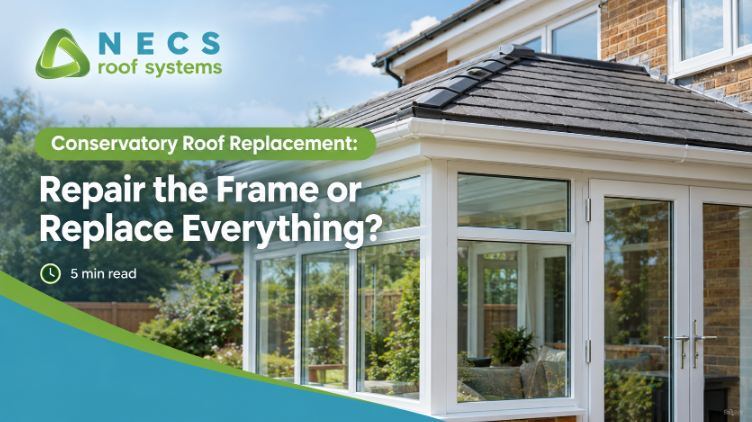
You’ve booked a survey for a new roof, and the surveyor has come back with a comment about the frame. Maybe it’s soft timber, a bowed sill, or a dwarf wall that’s moved. Now you’re wondering whether you’re paying for a roof on top of a conservatory that needs far more than that. The good news is that most frames can stay. The decision between a conservatory frame repair or replace comes down to a short list of checks, and you can understand most of them before anyone visits.
Why the frame matters more than the roof
A glass or polycarbonate roof is light. An insulated solid roof is heavier, because it has to be built to keep heat in and weather out. That extra weight sits on your existing frame and dwarf wall (the low brick wall the frame stands on), so both need to be sound before anything goes on top.
Replacing a glass or polycarbonate roof with a solid one also generally needs building regulations approval, which means the structure has to be shown to carry the load. That’s why a decent surveyor looks at the frame before talking about tile colours or finishes. If you want the full picture of how a replacement works, the replacement conservatory roof page walks through it.
What a surveyor checks, in the order they check it
On site, the order matters because each check can rule out the next.
- The base. They look at the dwarf wall and the ground around it. Cracks that run through the brickwork, or a wall that leans, point to movement underneath. Hairline cracks in old mortar are common and usually harmless. A crack you can slide a coin into is not.
- The frame material. uPVC, aluminium and timber each fail differently. Timber can rot at the base and at joints where water sits. uPVC tends to stay sound but can bow or lose rigidity if it was lightly built. Aluminium rarely gives trouble structurally, though the corner joints can loosen.
- The joints and corners. They press, tap and sometimes probe. Soft timber, gaps opening at mitred corners, or frames that flex under a hand are all noted.
- Squareness. A frame that has dropped on one side, or has twisted, will not take a roof system that expects a true, level base.
- Drainage and gutters. Water that has been running down a frame for years leaves its mark. Staining and rot below a leaking gutter are a very common find.
- The existing roof bars and eaves. These tell the surveyor how much of the old structure is carrying load today.
When repairing or reinforcing the frame makes sense
Most frames that get a mention in a survey fall into this group. If the base is solid and the frame is square, the usual answer is to keep it and strengthen it where needed.
That might mean replacing a section of rotten timber, tightening or replacing corner joints, or adding reinforcement so the frame can carry the heavier roof. Whether any reinforcement is needed depends on the frame, the span and the roof system, so it should be stated on the survey and the quote, not assumed.
In short, if the dwarf wall is in good condition and the frame is square and sound, most installers will recommend working with what you’ve got. It keeps the project smaller and keeps the cost down.
When replacing the frame is the better call
There are situations where patching is the wrong move. Pushing a repair onto a frame that’s failing just moves the problem down the line.
- Movement in the base. If the dwarf wall or foundations are still moving, a new roof will not stop that. The base needs fixing first.
- Widespread rot. A few soft spots can be cut out. Rot through most of a timber frame cannot.
- A frame that’s too light for the job. Some older or budget frames were never designed for a heavier roof, and strengthening them can cost nearly as much as starting again.
- Twisting or racking. A frame that has lost its shape is hard to put right.
- Several problems stacking up. One repair is a repair. Five at once is usually a sign the frame has reached the end of its life.
How the two routes compare
| Repair or reinforce | Replace the frame | |
| Typical situation | Sound base, square frame, isolated problems | Moving base, widespread rot, lost shape |
| Scope of work | Targeted fixes and reinforcement | Larger rebuild, often more trades |
| Disruption | Lower | Higher |
| Cost | Added to the roof quote as a defined item | Considerably more, and varies a lot by size and material |
Prices vary too much by size, material and access for a single figure to mean anything. What matters is that any frame work appears as its own line on the quote, so you can see what you’re paying for. Our conservatory roof replacement cost guide explains how that breakdown usually looks.
A mistake worth avoiding
The most common one is getting a roof quote that says nothing about the frame at all. It reads cleanly, but the frame problem still exists, and it tends to appear mid-job as a “variation” that adds to the price. Ask any installer to say in writing whether they’ve inspected the frame and base, and what they found.
Frequently asked questions
Can I keep my old frame and just change the roof?
Often, yes. If the base is sound and the frame is square and solid, many can be kept, sometimes with reinforcement. A survey is the only way to know for your conservatory.
Does a rotten window frame mean the whole frame has to go?
Not necessarily. Rot in one window or sill can often be cut out and replaced. It’s the extent that counts.
Will I need building regulations approval if the frame stays?
A solid roof replacement generally needs it, whether the frame is kept or not, because the structure has to be shown to carry the new load.